Too many children and young people spend large parts of the school day sitting still. This can affect well-being, motivation, and learning. A new initiative now aims to change that. The Centre for Childhood Health and Danish School Sports are leading a nationwide partnership together with six other organisations working to create a more active school day for children and young people.
The partnership “Sport and Physical Activity in Schools” is one of the largest national collaborations in this field. With a new grant of DKK 26 million from the Centre for Childhood Health, the initiative will now be significantly scaled up and reach up to 28,000 students. Experience shows that physical activity not only makes children healthier – but also happier and more motivated to learn.
By 2030, 8–10 municipalities and 55 schools will receive direct support from the partnership. In addition, materials will be distributed to a further 100 schools, enabling them to develop their own approaches to integrating movement into the school day.
A school day that can be felt
The goal is for students to experience a tangible difference in their everyday lives.
This is not only about adding more PE lessons, but about a so-called whole-school approach, where movement becomes a natural part of the school day.
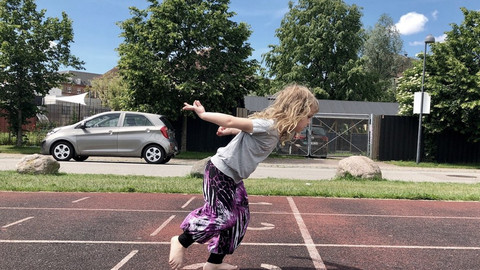
For students, this means, among other things, teaching with more variation and activity, less time spent sitting still all day, more learning experiences involving the body, and greater energy and motivation to participate in lessons.
Movement can include short classroom activities, learning through physical engagement, transport to school, play during breaks, use of outdoor spaces, and more – all adapted to each individual school.
From knowledge to reality
The partnership consists of the Centre for Childhood Health, Danish School Sports, Danish School Students, the Danish School Leaders’ Association, School and Parents, DGI, Steno Diabetes Center Copenhagen, and the University of Copenhagen. The initiative builds on several years of work in which schools, students, and professionals have helped develop and test what works in practice.
The experience is clear: movement can strengthen well-being, learning, and community – but only if it becomes an integrated part of the school day.
“We now know that physical activity can make a real difference to children’s and young people’s well-being and learning. We now have the opportunity to take the next step and make it part of everyday life at many more schools – so it does not become isolated activities, but something that is naturally integrated into the school day and leisure time and felt by students every day,” says Annegrete Juul, Director of the Centre for Childhood Health.
Focus on all children
A central ambition is to reach all students – including those who do not feel at home in traditional sports.
That is why the partnership works with an approach where movement is about participation, community, and positive experiences rather than performance.
“This is not about creating more elite sports talents. It is about giving all children positive experiences with movement throughout the school day. We know there are many children who do not necessarily thrive in traditional sports – and we need to reach them too. When movement becomes part of teaching and the school community, more children can participate and experience that they truly belong,” says Bjørn Friis Neerfeldt, Secretary General of Danish School Sports.
Support for schools
With the grant, schools will receive concrete support to work with movement in everyday life.
This includes competence development and professional sparring, networks and exchange of experiences, funding for activities and local school initiatives, and time and resources to develop each school’s approach to movement.
The ambition is to make it possible for schools to work with movement as a natural part of their practice – not as an additional project. The goal is clear: more children experiencing a school day and leisure time with more movement, stronger communities, and a greater desire to learn.
The initiative will begin in 2026 and continue until 2030.