New Study: Primary Schools Want to Promote Children’s Well-Being and Health.
We are behind a new, large-scale national study, which shows that the vast majority of school leaders and staff at primary and lower secondary schools across the country consider promoting pupils’ well-being and health an important part of the school’s mission.
It also shows that most schools recognise the close connection between health, well-being and learning.
The study, entitled How Danish Primary and Lower Secondary Schools Address Student Well-Being and Health, is the first of its kind in Denmark to examine both schools’ day-to-day practices and their overall capacity to promote student well-being and health.
An Important Framework for Children’s Lives
This comprehensive survey is based on responses from more than 7,000 teachers, pedagogical staff and assistants, as well as school leaders from public schools, special schools, independent schools and private schools across Denmark.
The survey aims to provide insight into how we and others can support initiatives to promote health and well-being in schools. Our CEO, Annegrete Juul, says:
“School is one of the most important settings in children’s everyday lives and therefore also a place where they can be encouraged to adopt healthier habits. However, this requires health promotion to be meaningful to school leaders and staff in the context of their core responsibilities. That is why we asked them,” she says.
Health Promotes Concentration and Learning
Annegrete Juul is pleased that school leaders and staff do not appear to see a conflict between delivering academic content and promoting children’s well-being and health.
“Well-being is a prerequisite for learning. This has become clear from the discussions about student well-being in recent years. It is encouraging that greater attention is now also being paid to students’ physical well-being. We know that children who get enough sleep, eat healthily and are physically active are better able to concentrate, and that their brains are better equipped to learn new things,” she says.
The Greatest Challenges Are Among the Older Students
However, the study also shows that there can be a gap between schools’ intentions and their day-to-day practices.
The figures show that only 19% of teachers believe that “students experiencing well-being or health challenges receive the necessary support through a coherent and well-coordinated process”. Furthermore, only 27% of all staff feel they have sufficient time to follow up with students facing well-being or health challenges.
The study also shows that staff report the greatest challenges related to well-being and health among older students, while initiatives to promote well-being and health are more prevalent in the lower grades.
However, Annegrete Juul does not believe this necessarily needs to become a debate about allocating more resources to schools.
“A great deal of work is already being done to promote well-being and health in many areas, and most people agree that this is an important part of schools’ responsibilities. So I believe it is more a question of priorities and, potentially, developing new skills and competencies to ensure that more people feel that initiatives are reaching the right students and being followed through,” she says.
- 96% of school leaders believe, to a high or very high degree, that schools have a responsibility to help promote the health and well-being of children and young people.
- 84% of staff say that their school operates on the understanding that students’ learning, well-being and health are interconnected.
- 90% of school leaders say that promoting health and well-being is a high or very high priority for them.
- 67% of staff agree.
- Many school leaders and staff report that students face challenges in the areas of sleep, body image, drinking habits (consumption of sugary drinks) and social media.
- At schools where the overall socioeconomic status of the student population is below average, staff generally report more challenges related to student well-being and health.
- However, they do not experience correspondingly stronger organisational support structures.
- 7,056 respondents, including 6,020 staff members (teachers, pedagogical staff, pedagogical assistants, childcare assistants and other staff) and 1,036 school leaders (senior leaders and middle managers).
- The study explores, among other things, perceptions of student challenges, schools’ written policies, day-to-day practices, knowledge and skills, shared responsibility, organisation, collaboration, early identification, and available frameworks and resources.
The study was conducted by the Centre for Healthy Living and Well-Being in collaboration with Statistics Denmark’s Survey Department.
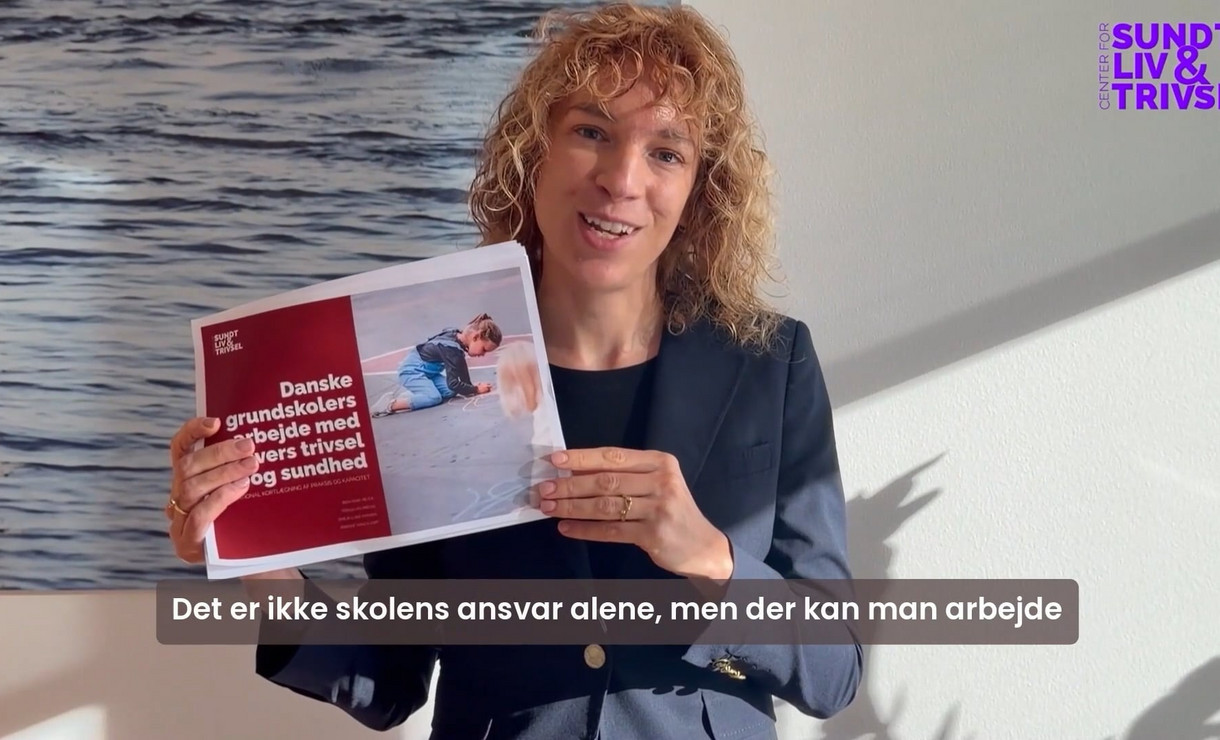
Hear Senior Project Manager Anneke Vang Hjort talk about the work behind the report on Danish primary and lower secondary schools and highlight some of its key findings here:
We need your consent
You need to accept functional cookies to watch Vimeo videos